

What Is an Engineered Door? How It's Made, Layer by Layer
What Is an Engineered Door and How Is It Made?
An engineered door is a laminated product with a skin to withstand impacts, core to bear weight and insulate, an internal frame for stability and a coating that resists the elements. It is a product manufactured to size on a production line rather than a hand-crafted article.
Get out the search engine and type in 'engineered door'. If half the search results are about engineered wood, you're already getting confused.
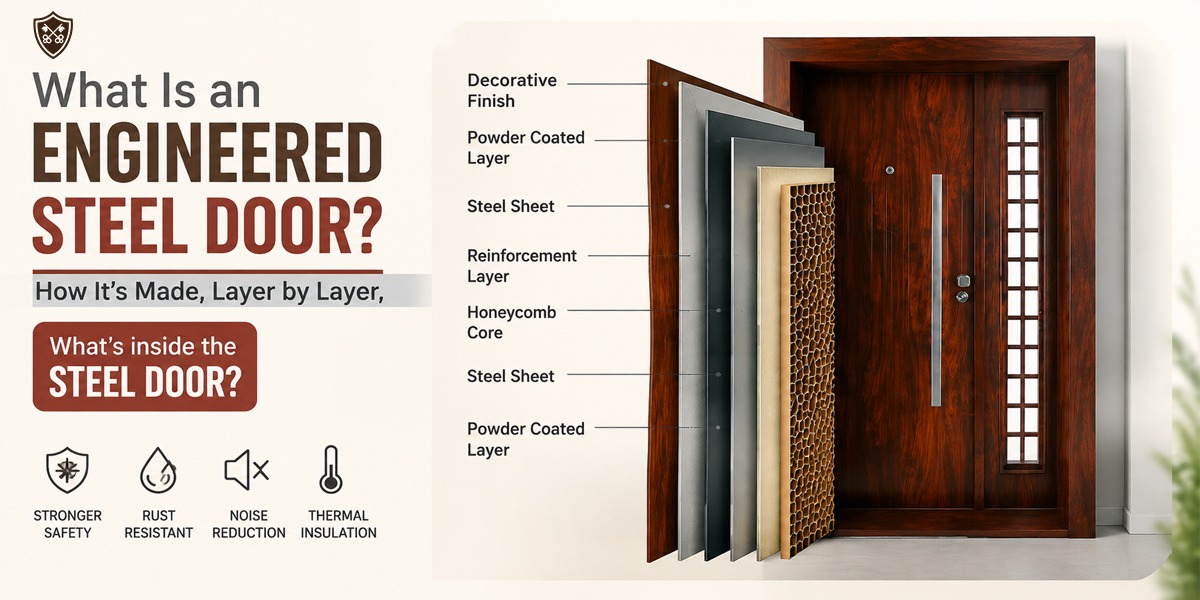
What's inside ? If you were to split a Duroguard door down the middle, you'd find five things:
The outer and inner skin. Galvanised steel sheets of varying thickness. The thickness bears directly on its ability to withstand impacts and knocks.
The core. Either a honeycomb structure or PU foam or rockwool (in doors that have a fire rating).
The internal frame. The stiffeners that run through the door. They stop the door from bowing out after four years on its hinges.
The coating. In this case, a three-step process of priming, powder coating and finishing.
Hardware reinforcements. Additional steel around locks and hinges. Without this, a door's hardware becomes its weakest point.
Remove any of these, and the door will still look beautiful on your premises. But it will stop being an engineered door.
How it's made ?
1. Coil selection. The coil of galvanised steel is one of the most critical choices. It determines the thickness and grade of the door and, more importantly, all subsequent choices are made with this in mind.
2. Cutting and pressing. The steel sheets are cut to the appropriate sizes. They are pressed to give the door its shape including the internal rebate.
3. Core filling. The core is added in between the two steel skins. The density of the core is important: a door with a low density core will be a light door. But it will feel cheap when you test it.
4. Welding and joinery. The welds on the door's skins and frame are spot welds. The edges are joined together seamlessly.
5. Surface treatment and coating. This is a five-step process that includes degreasing, phosphating, priming, coating and oven curing. It determines how soon your steel door will start rusting from the bottom.
6. Testing and dispatch. All doors are tested in salt-spray chambers and their hinges are load-and-cycle tested before they are ever dispatched to you.
Where things go wrong
Most problems stem from issues around four elements:
Gauge. Low gauge steel causes dents. You'll see these after a year of use.
Core density. This leads to problems with sound and thermal insulation. A low-density core makes for a light door, but it also lets all sounds in and out.
Coating hours. Salt-spray hours are the standard way of measuring how well the coating protects the steel. Anything below a certain threshold and you'll notice rust on the bottom edge after a couple of years.
Tolerances. A half a mm's difference in a joint can cause binding during hot months. These are the issues no one thinks about but everyone wishes was addressed in their purchase.
Why it matters here
South India is unforgiving. Doors have to withstand Kerala's salinity, the searing heat of Coimbatore, the termite menace and the sudden deluges of the monsoon. An engineered steel door does not react to heat and humidity the way an ordinary wooden door would. Nor does it shrink or expand with the seasons. It does not allow termites to feast upon its wooden parts and weaken the framework.
We don't claim to have thought of everything. We have been building doors for a while. These have been tested, in the real world, across 15,000 homes.
Frequently Asked Questions
Everything you need to know about this topic

Comments